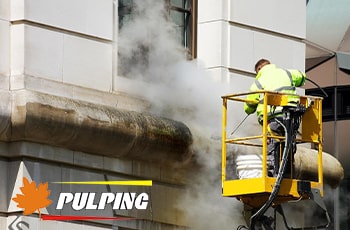
Types of pollution of the facade of the building
In this article, we want to talk about the types of pollution on the facade of the building, what are the types of pollution on the facade of the building and what are the factors that affect it, what is the effect of the urban design, and what questions may arise for you, so stay with us for further reading.
The pulping collection provides many services such as building construction, the role of color in building renovation and renovation, the color of urban buildings, types of staircase flooring, facade paint and granite facade coating and building construction stages, building paints, construction equipment and Thermal insulation of the facade of the building and palpation and Building coatings against weathering special activity.
Pollution of the facade of the building
Pollution of the facade of buildings is of great importance in beautifying the appearance of the city; For this reason, special attention should be paid to beautifying and cleaning them from pollution. Indiscriminate expansion of cities in the world is the main cause of serious environmental problems and pollution in cities. In the construction industry, chemical, fungal and bacterial pollution and airborne particles are among the major environmental pollutions that directly affect the facade of the building.
Urban landscape
The urban appearance is all the elements and factors of the city that can be seen and the eye is able to watch and are formed in the human mind and memory. In the meantime, what is very important visually is the coordination and structural integrity of the buildings and places that make up the urban environment. According to this definition, the beauty of the facade of buildings in terms of their color appearance and maintaining the cleanliness of their surface play a significant role in the beauty of the urban environment.
Covering buildings
Due to the importance of the facade of the building in the discussion of the aesthetics of the urban space, cleanliness and the appearance of its color are very important. On the other hand, the development of urbanization, the growth of the population and industrial factories, etc., have caused an increase in pollution and visual disturbances in the urban space, and it has caused the facade of the building. will quickly change color and become dark and dirty. The facade of the building is directly affected by the weather. Air pollution through the natural method of wind, high and low temperature, radiation (solar) and complex chemical and biological processes affect the appearance of the facade. The color change in the exterior of the building is often due to various reasons such as carbonation, corrosion, cracking, soil deposition and dirt, biological effects and other cases. The most common example of color change in the exterior of the building is darkening and blackening, which is considered to destroy beauty and has important social consequences for the building in terms of visual perception. These blackened surfaces cause visual disturbances. The darkness of the external facade, especially the facade with light coating, finally reaches a point that is unacceptable from the point of view of aesthetics. It is not created uniformly on the surface. The process and the different amount of blackening of the building can be effective in deciding on the cleaning of the building.
Factors of building facade pollution
Air pollution is considered one of the most important environmental challenges due to its direct impact on ecosystems and human health. This type of pollution sticks to different surfaces and overshadows the beauty and appearance of their color. Air pollution is divided into several categories, the primary air pollutants and their sources are briefly mentioned below.
Chemical pollutants
Air pollution is a complex mixture of particles, vapors and gases emitted from natural and anthropogenic sources, and is also formed through photochemical conversion processes. In urban areas, air pollutants are composed of combustion emission, a combination of emitted particles, carbon oxides, sulfur and nitrogen, volatile organic compounds, and secondary reaction products such as ozone, nitrogen dioxide, and secondary organic aerosols. In general, chemical pollution is caused by carbon monoxide (CO), nitrogen oxides (NO), sulfur oxides (SO), particulate matter (PM) and volatile organic compounds (VOC). The natural and human sources of pollution are listed in the table below. .
Chemical polluting agents, natural resources producing pollution, human resources producing pollution
1. Carbon monoxide (CO)
2. Nitrogen oxides (NO)
3. Sulfur oxides (SO)
4. Particulate matter (PM)
5. Volatile organic compounds (VOC), volcanic eruptions, forest fires, photochemical reactions in tropical areas, decay of organic matter
Thunderstorm and biological decay processes
Biological decay processes, volcanic eruption
Pollen, bacteria and fungi, dust, soot ash
Hydrocarbons (terpenes) are emitted from trees and other plants. Exhaust from motor vehicles, power generation facilities and other incomplete combustion processes
Combustion of fossil fuels in electrical installations, high temperature operation, pollution from motor vehicle exhaust
Burning of coal fuel and oil containing sulfur, metal melting, industrial processes
Electricity generation, industrial processes, combustion of fossil fuels
Trash disposal
Use of vehicle exhaust solvent for industrial processes
Acidic pollutants
Among the most important destructive effects of acid that damage the appearance of the building is acid pollution resulting from acid rain. Clean rain is slightly acidic due to the presence of carbon dioxide in the air; Because water produces carbonic acid after reacting with this gas, which of course is a weak acid. But in polluted air, due to the presence of nitrogen oxides and sulfur or sulfur, stronger acids are formed. These acids are nitric acid and sulfuric acid respectively. The main sources of these pollutions are cars, industrial facilities and power plants. In the 1970s and 1980s, public concern about the impact of acid rain often focused on its possible damage to outdoor artworks, including details of sculptures and buildings. He said that the loss of cultural heritage will increase exponentially until the end of the millennium find
The decrease in pH and the presence of aluminum in surface water are both results of allergic and bacterial acid rain. Acid rain can cause the destruction of buildings, especially historical buildings and treasures, and over time, it can destroy some surfaces of old buildings and historical statues. This is due to the reaction of calcium compounds with sulfuric acid. Acid leads to the destruction of the protective layer of metal equipment and their rusting. As a result of acid rains, the stone surfaces of buildings, bridges, dams, etc. are worn away and cause their destruction over time. Among the damages caused by acid rain, it is possible to change the shape of famous buildings such as the Parthenon (Athens), the Statue of Liberty (New York), St. Paul's Church (London), the Taj Mahal of India), Trajan's Building (Rome) and the old church of Cologne (Germany). He pointed out the effect of chemical wear. The reason for this is the reaction of acids from dust and acid rain with the lime on top of these buildings. These chemical reactions turn the limestone of the facades into powder and reduce their thickness. A clear example is the reduction of more than 8 mm in the thickness of the marble statue of Abraham Lincoln in Washington.
respiratory diseases, frequent wheezing, atopic dermatitis and infections in humans, one of the most important factors that due to velic acid and reductive oxidation corrosion of materials, eventually leads to the formation of harmful crusts on the surface of facades, especially stone facades, pollution with It is a microbial material. By knowing the factors that pollute the building facade, the next step is to find solutions to avoid creating surface dirt. One of the most important solutions is the use of suitable coatings, which will be discussed further.
Fungal and bacterial contaminants
Another factor of construction pollution and dirt (both indoor and outdoor spaces and facades) is fungal and bacterial contamination. Fungal spores exist in large quantities in the air and outdoors, and unlike fungal spores in indoor spaces, by modifying the surface of the coating Buildings and other methods can be controlled, the creation of fungi is often related to their symbiotic relationship with environmental organic matter in the open air, and it is not possible to prevent them from being created easily. Exposure to fungal spores, the possibility of damage to the lungs and It results in adverse and irreparable effects. These effects on the lungs may not have obvious symptoms, but in the long run, they may cause chronic diseases.
Suitable coatings to increase surface resistance against dirt
One of the ways to protect against pollution and dirt and increase chemical resistance, especially in the discussion, is to apply suitable coatings or use a color coating that is very resistant to dirt. The use of such coatings requires that the chemical compounds used in the paint or functional resin do not harm nature and the environment and do not change the appearance of the facade. These coatings are often compounds containing polymer resins of the type of water-based acrylic resins, in the following, it is mentioned to examine some methods and coatings that are applied as a coating on the facade surface to increase the resistance of the surface against dirt.
Antibacterial and anti-fungal coatings
In order to apply coatings with anti-bacterial and anti-fungal properties, features such as being environmentally friendly and resistant to new microbial species are also considered. These coatings should also not have a harmful effect on the facade and be resistant to ultraviolet rays. Molecular weight has an important effect on antibacterial activity.
Self-cleaning coatings
In this method, instead of using hard and expensive methods to clean the entire building coating, you can use a self-cleaning coating to help maintain the cleanliness of the building facade for a long time. Titanium dioxide pigment is considered as a coating, which in When illuminated with ultraviolet rays, it has the property of a photocatalyst. TiO2 paint mixture is used as a self-cleaning coating due to the creation of a film layer with excellent properties such as stable adhesion, backing and reversibility of being removed from the surface after application. Also, the mixture of TiO paint shows a good ability to absorb water and acts as a water-absorbing material. Accordingly, adding TiO2, while painting the facade of the building, can be considered an economical method to reduce pollution, especially in developing countries.
Building waterproof coatings
Polyacrylic siloxane waterproof coatings are considered in various applications due to their high durability and good characteristics. Adding polysiloxane in the composition of polymer particles improves the hydrophobic properties and mechanical properties of the composition. Also, the use of these compounds in the coating of paints used on the exterior improves the properties of the paint, such as increasing the resistance to rotting and weathering. be made Also, the use of silica nanoparticles in the paint formulation increases the resistance against water and dust penetration, which makes the paint self-cleaning. As mentioned before, one of the ways to increase the resistance against rotting is the use of resistant coatings, which addresses some of the most important coatings used in the facade of the building to improve the properties and increase the resistance of the surfaces against dirt and discoloration of the facade of the building. One of the ways to control the quality of the coating used in terms of resistance to dirt is to measure the degree of its permeability. According to the topic of the present article, several researches conducted regarding the measurement of the dirtiness of the used coatings based on colorimetric methods and changing the color appearance will be discussed.
Conclusion
contaminated In addition to the harmful effects on the health of humans and other creatures, the air in big cities or developing cities in the long term has side effects on the facade of buildings and distorts the beauty of the facade and thus the appearance of the city. To solve this problem, various types of covering are applied on the facade of the building, the coatings used may be anti-bacterial and fungal coatings, self-cleaning coatings or water-repellent coatings, which are selected according to the climate of the building and the characteristics of the coating.
Pulping set:
If you decide to implement the pulping of the facade of the building; You can ask the pulping group with a brilliant experience in this field. We hope that the information we provided about facade pulping and facade coverings has been useful to you. For more questions, you can contact our experts for an answer as soon as possible. Thank you for staying with us until the end of the article.